Tuesday, February 2, 2016

Pinson Alabama

Pinson, Alabama is a small out of the way community that even the locals in the area don't seem to know much about.  As of 2010 census, the total population was 7,163.  Pinson wasn't even officially a town until they incorporated on March 30, 2004.  

Downtown Pinson ca. 1911


When I decided to research the town, I was pretty amazed at the wealth of history this town has. 

For instance, did you know:

1. Pinson is one of the oldest settled areas in Alabama;
2. It was settled before Alabama was even a state;
3. It once was settled by ancient Native Americans (Creek, Muskogee)
4. Pinson is home to one of the oldest known (ca. 900 CE) cave dwellings & burial sites in the entire United States;

These are just a few of the interesting historical facts about the Pinson area.  How did Pinson come to be?

It would be impossible to tell the story of Pinson without telling the stories of the Turkey Creek Nature Preserve and the the Greene Cemetery.  These two landmarks are so intertwined with the history of Pinson that to omit them would be omitting the majority of Pinson's history.

The Turkey Creek Nature Preserve

The Turkey Creek Nature Preserve is located just off Highway 70 past Pinson's Main Street.  This 466 acre Preserve offers free admission, hiking, fishing, swimming, an annual fishing tournament, marathon, boating event, it hosts the State's butterbean festival among many other great events and recreational activities.  They also offer hands-on educational events for local schools, boy scouts or anyone else wanting to know more about nature and/or history.

The rich history of Turkey Creek dates back to documented prehistoric Native American inhabitants.  During the early days of the Alabama statehood, the preserve played a key role in the birth of industry in this area by the works of early entrepreneur and industrialist, David Hamby.  The Hamby family ran a grist mill and a small iron forge on the banks of the Turkey Creek.  David Hamby's forge made horseshoes for the Confederacy until he was killed by a Union Soldier on April 19, 1865. 

Turkey Creek is home to 3 endangered species of fish.  

The Vermilion Darter  (occurs only in Turkey Creek and nowhere else in the world.)


the Watercress Darter


 and the Rush Darter.


Turkey Creek is also home to a threatened bat species (long eared bat), 


an endangered bat species (Grey Bat), 


an endangered turtle (Flattened Musk Turtle) 


and an endangered flower (Eared Coneflower).  


This makes  a total of 7 protected species that can be found at Turkey Creek Nature Preserve, making it one of the most critical habitats for rare species in the entire country.


Woodland Period Cave

Turkey Creek Falls Swimming hole is one of the most popular swimming holes in the state.


Greene Cemetery 
(aka Greene's Station Cemetery, Greene Family Cemetery, Greene-Massey Cemetery or Smith's Chapel Cemetery)


Greene Cemetery reads like a Who's Who of the early pioneers of Jefferson County Alabama.  It's located on Kent road next to Kent Corporation near the main campus of Jefferson State Community College on Highway 79.  It's adjacent to, but not affiliated with, the Smith's Chapel Methodist Church on the Old Huntsville Rd.  This area began to be settled in 1817 and many of the early pioneers and slaves are buried in this cemetery.

The cemetery began as a family cemetery for the Greene family who owned a considerable amount of land holdings in the area.  The oldest known burial is 1829.  However, 2 of the oldest residents are that of Goldsmith Whitehouse Hewitt (a veteran of the American Revolutionary War) who died in 1846 and George Nash who died in 1852.  George Nash was the father of Zachariah Hagood's first wife, Nancy Nash.

Goldsmith Whitehouse Hewitt's son (Goldsmith Whitehouse Hewitt, Jr.) was a Captain in the Confederacy, graduated from Cumberland School of Law (when it was in Lebanon, TN), served in the State House of Representatives, The State Senate and as a Congressman from 1875-1895).  He died on May 27, 1895.
Photo of Goldsmith Whitehouse Hewitt, Jr.


Originally the land between Tarrant and Pinson was known as Greene's Station.  Brothers George Livingston Green and Robert Hardy Green both built large plantations in the area.

Headstone of George Livingston Greene (died 6-22-1875)

The cemetery is the final resting place of Zachariah Hagood who was one of the earliest physicians in Jefferson County.  He practiced from 1840 to 1856.  Zachariah had 21 children from 3 wives.  His son Robert built a store at the crossroads next to Huntsville road in 1836 which also functioned as the first post office for that area.  Soon that area was known as Hagood's Crossroads.
Headstone of Zachariah Hagood (11-21-1792 to 2-21-1875)

However, horse traders settling there from Pinson, Tennessee soon outvoted the Hagood's and it became known as Mount Pinson which was later shortened to Pinson in 1895.

Another permanent resident of the Greene Cemetery is Thomas Haughey.  He was a physician who owned land in Pinson.  He served as a Republican Congressman in the years following the civil war.  He was assassinated in Courtland, Alabama while making a speech in 1869.


Pinson, Alabama is a scenic area with rolling hills, deeply wooded plots that go on for miles and historical treasures tucked in along the way.


Friday, January 8, 2016

Is your space really too small or is your stuff just too big?

Why do you really want to move?  Need something larger, smaller, cheaper, nicer?  Maybe you want more land or less land.  Like to live closer to work or maybe as far away as possible? There are a bazillion reasons that people move.  All of them perfectly legitimate.  But sometimes folks think they have to move when they really don't.


After all, moving is not a quick or inexpensive chore.  Just trying to remember everyone I need to notify of my new address is enough to make me want to stay put.

If you want more land or less land than what you currently have, I'm afraid moving is your only option.  But if you like your location and lot size but don't think you have enough interior square footage or your space just seems tired and boring, sometimes that's a problem that can be solved.

You would not believe the number of people who move because they don't think they have enough storage space or they think they've "outgrown" their space when in fact, they didn't. What they did do, is try to cram more stuff into their house than it would hold.

I've always said that these types of people are bordering on being hoarders with money. People who have money and good credit can always buy a bigger house when they've succeeded in stuffing their present one to the gills.  The ones without money and good credit show up on that reality TV show about hoarders.

The things  that seem to overwhelm people and make them want to throw their hands up in the air and move are (1) clutter from their children (2) cluttered entryways/mudrooms (3) kitchens that they think are too small and (4) playrooms and/or bedrooms that seem too small. 

So let's address these one by one.

(1) Clutter from Children.  


Want to know why there's clutter from the children driving you nuts?  It's really pretty simple.  The children have way too much stuff, they are not taught how to pick up after themselves or both.  

Look at the picture below.  No child needs that many items out at the same time....as a matter of fact....no child needs that many items at all.

Even children as young as 3 can do simple chores. At that age, if you slap on a bright enough smile with a happy enough voice, they will do it in record time and be super excited about it. The key is not making it appear to be a chore and be consistent about making them put their own toys away.  

Children should be taught very early on that if they get a toy out, they have to put it back when finished before they can get another toy. Once children form a habit of picking up after themselves, it become a habit that they will keep throughout their lives.  But it all has to begin with the parents.  If mom or dad makes them pick up their toys today but then tomorrow, they allow the toy to remain in the middle of the floor.....they have to begin all over again with training.

Studies have proven that children have the ability to concentrate and actually engage in playing with a maximum of 3 toys at any time. So don't allow the kids to drag out every toy they own.  It's pointless and creates an unnecessary chaos in your living space. A very important thing to remember is boredom.  If your child sees the same toys all day every day, they grow bored with all of them and then they want more - but they don't want to get rid of any of the old ones......see the cycle?

Now what about children clutter that is caused by the adults?  Parents do you really need to have car seats, strollers, bouncy seats, play pens, changing tables and high chairs in every room?  As a matter of fact do you really even need these things in view when not in use?

Some parents, especially first time parents, go nuts when they have kids.  They go out and buy every piece of child furniture, accessories, clothes and toys that they can find.  Somehow all those things inevitably wind up strewn about the common areas and entryway.  Then the parents wonder why they have "outgrown" their house.  

(2) Entry ways and/or Mudrooms


Houses get a bad rap from entryways.  The rest of the house can be awesome but if that entryway is small and/or cluttered, people soon develop a bad attitude about the entire house. Entryways were designed to be exactly what the name implies....an entryway.  They weren't designed to house all your coats, shoes, boots, strollers, backpacks, etc.

It's so much easier to take off your coat and boots and then carry them to your bedroom than it is to trip over them in the entryway.  Another plus to taking them with you when you enter the house is purely logistic.  If you take off your coat and boots and leave them at the door, then tomorrow when you get ready to leave the house, you will grab another pair of boots and another coat and wear them to work or school.  Then when you come home, you'll leave those by the door and when you get ready for work or school the next day.......see how it can all pile up and get out of control?

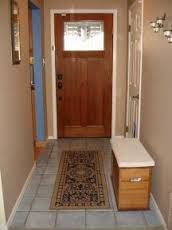
Does the picture below look like your entryway?


If you simply cannot or will not take your belongings with you, then how about purchasing a bench with storage inside?  Sit on top to take off your boots, open the lid and toss them inside. Out of sight.

(3) Kitchens

Nearly everyone that mentions moving mentions the kitchen.  It's too small, there's not enough storage, it's outdated.  The kitchen below would make me want to move pronto!


This is actually a good sized kitchen with plenty of storage.  However, every single surface has something on it.  There is nowhere to even sit a cup.  

I used to be bad about fridge magnets.  Every inch of my fridge (including the sides) were covered with them.  I began using them to keep schedules on the fridge, or notes to myself or other family members or to showcase the kids artwork or schoolwork but somewhere along the way, I collected so many that it just took over.  Once I put them in a box to donate, I marveled at how clean my fridge looked and how much larger my kitchen felt.  The same effect was achieved when I took my pot rack down. While I loved it and loved the convenience it offered me, the feeling of spaciousness after I took it down was well worth the extra step of bending over to get a skillet.

A clean and uncluttered room gives you serenity and induces a calmness.  I don't mean to imply that you should toss out everything you own and go minimalist - I hate minimalist - I'm simply saying maybe toss half and what you don't toss, hide.  If you use your crock pot every day, keep it on the counter.  If you only use it once a week or once a month - it can go to a cabinet or into the pantry.  Same thing applies with toasters, mixers, blenders, etc.  Anything you don't use on a daily basis should not be seen.  

Lots of people will read that and reply that while it sounds nice, it's just not feasible to do this because the cabinets are already filled with dishes, drinkware, etc.  The key to accomplishing this trick is to reduce the amount of items already housed in your cabinets. 

With plates and drinkware, I keep 8 of each in my cupboards, the rest of them go into boxes and sit on the floor in my pantry.  If I have company, I take them out if needed.  With cookware/bakeware, I keep the ones I use the most in my cabinet by the stove.  The rest of them, again, are boxed up in my pantry.  When I have company for dinner or for holidays, I take them out but once I'm finished - back into the pantry they go.  See?  I didn't throw them away or donate them.  I just hide them away which makes plenty of room for me to store the things that once lived on my counters.  

As a result of the above tips, I have a kitchen that I enjoy being in.  I have a kitchen that never feels cluttered or out of sorts and I am never embarrassed whenever anyone pops over unannounced.

(4) Playroom and Children's Bedroom

If you follow my advice about drastically cutting down on the number of toys you allow your children to keep, then you shouldn't have any issues with maintaining order in their playroom or bedrooms.

A few bookshelves, toy chest, light colored paint and furniture that is smaller in scale will open these rooms up and make them appear much larger than they are.  They will become places where your children will want to be.

Check out the before and after below.

Now we're back to the original question.  Why do you really want to move?  Obviously you liked your house enough at one time to actually move into it.  At some point you simply fell out of love with it.  It's time to figure out why you fell out of love and fix it.

If decluttering it still doesn't do the trick, try rearranging the furniture and painting. Bedroom causing you fits?  Google bedroom ideas and you will see a ton of ways to enhance your bedroom making it feel brand new once again.

I have written on the topic of how to fall back in love with your house before.  I am a firm believer that unless you want more or less space or unless the surrounding area has become unsavory, there's really no reason to go through all the hassle and expense of moving.  Just grab that paint brush and those boxes and get to painting and donating.

Enjoy your space!

Tuesday, December 1, 2015

White Christmas in Birmingham, AL?

Each year as Christmas approaches, people begin to dream of a traditional white Christmas.  But in central Alabama...it remains only a dream.

For Birmingham, where over 100 years worth of weather records are kept by the National Weather Service, there has never been a truly white Christmas.  The closest we have come was in 2010 when on Christmas day there was a mixture of snow and rain that fell for a couple of hours.  However, there was no accumulation.  Birminghamians had to be content with watching the snow fall and looking at the thin accumulation of snow on our rooftops and the very tops of the grass.

Below is a shot of the Wedding Chapel on the Mountain.  It was not taken on Christmas Day..but it does represent what we all want to see when we wake.

The newspapers called the December 25, 2010 weather a "rare snowstorm".   Other media outlets called it "The first White Christmas in the history of Birmingham".   It caused multiple accidents and the few businesses that were open that day closed early or didn't open at all.  Below is a picture of the accumulation of snow.  Not much to see is there?

Here's another picture of the accumulation in 2010.  Notice the walkways and driveway is 100% snow free.  For those not from Birmingham, it was not shoveled or cleared.  We don't do that down here.  It's just that the ground was so warm the snow only stuck to the tops of the grass and roofs of the houses.


  On December 22, 1929, Birmingham actually received 5.5 inches of snow.  December 22 is close enough...don't you think?  By December 24, we still have 2.5 inches left.  However, Christmas Day, the temperatures were 51 degrees so by nightfall all that was left was slug and slush.


Usually Christmas Day in Birmingham, AL is clear and warm or at a minimum warmish.  We show up to relative's homes in short sleeves or at a maximum wearing a sweater.  Christmas Day 1979, a group of us actually went swimming.  It's not Florida weather, but it's good weather.

This is really one of the things that I love most about this area.  I don't want a white Christmas that will keep my family away or at a minimum make it difficult or dangerous for them to get to my house.  I like that we don't get our snowfalls until February or March.  Normally we get one or maybe two nice snowfalls per year.  I'm really good with that.  I get to enjoy a snowfall each year but not so much snow that it impacts or greatly inconveniences my life.  It's a win win in my book!

Merry Christmas to everyone!!

Saturday, October 31, 2015

The Tutwiler Hotel

A lot of people don't realize that the Tutwiler Hotel located at 2021 Park Place near Linn Park in downtown Birmingham is not the original Tutwiler Hotel.

The building we know as The Tutwiler was originally the Ridgely Apartments.  The Ridgely Apartments was built in 1913 by Robert Jemison, Jr. and Edward Tutwiler to serve as a high end apartment complex.  It consisted of a total of 120 rooms and apartments.  By the time Temple Jemison decided to transform the Ridgely into the new Tutwiler Hotel in 1986, the Ridgely only had between 30 and 35 tenants left in the entire building.  Most of these tenants were elderly people who had lived in the building for decades.  The rest of the building was vacant and in serious need of repair.

Photo of the Ridgely Apartments shortly after its grand opening, circa 1913

The original Tutwiler Hotel  was a 13 story brick and limestone luxury hotel located on the southeast corner of 5th Avenue North and 20th Street.  Constructed in 1914 by a group of local investors.  It closed in 1972 and was demolished in 1974.


The Tutwiler in 1930
Lobby of the Tutwiler in 1930

In 1913 the President of the Tennessee Coal, Iron and Railroad Company complained to Robert Jemison, Jr. of the lack of decent hotel accommodations in the city.  Jemison teamed up with Harvey G. Woodward, W.P.G. Harding and Major Edward M. Tutwiler, who had just sold his interest in the Birmingham Coal and Iron Company to the Woodward Iron Company the year before.  Major Tutwiler agreed to underwrite the first mortgage and the creation of the Tutwiler Luxury Hotel was off and running.

Major Edward Magruder Tutwiler 

Robert Jemison, Jr.

William  P. G. Harding

The lead architect, New Yorker William Lee Stoddard and local architect William Leslie Welton, accompanied by Hotelier Robert R. Meyer, visited the vanguard of the "Metropolitan Hotels" of the day in other cities to study both their best features and their worst mistakes.  The result blended the Slaten Hotel in Cincinnati, the Blackston Hotel in Chicago, the Vanderbilt hotel in New York and the McAlpin Hotel in New York.

When it opened, it was like nothing the area had ever seen before.  Among other luxuries, the interior featured what the Birmingham Age-Herald proclaimed to be the "Biggest Lobby in America" furnished with heavy "Elizabethan" furniture and dressed with marble walls.  The developers spent $400,000.00 on the furnishings alone.  That figure equals to $9,642,585.86 in today's money.

The doors officially opened on June 15, 1914 and all the leading citizens of the area turned out in droves dressed in their best formal attire to see the "Grand Dame of Southern Hotels".  

The Tutwiler consisted of 325 rooms.  All were equipped with either a bath or shower and telephones.  Rates ranged from $1.50 to $6.00 per room.  That would be the equivalent of $36.59 to $146.34 in today's money.

For the next 60 years, it was a hub of Birmingham playing host to hundreds of celebrities, politicians and dignitaries.

President Warren G. Harding presided over a luncheon in his honor at the hotel during the Birmingham Semicentennial in 1921. Charles Lindbergh held a press conference in the Louis XIV suite in 1927.  In 1937, actress Tallulah Bankhead threw a rousing post-wedding party in the Continental Room which for decades hosted lunches and dinners with live big band music 6 days a week.  Also, novelist Jack Bethea hanged himself in one of the guest rooms in July, 1928.

In June, 1967 the Tutwiler was sold to the local Great Southern Investment Corporation for $1.7M.  James P. Paris, head of the investment group, announced they expected to spend up to $1M to renovate the entire hotel and planned to market the hotel's Regency Room Ballroom as an alternative to "The Club".  However, just 5 years later, the hotel closed for good on April 1, 1972 and was demolished on January 26, 1974.

1985 saw a new interest in the Tutwiler and it was decided to convert the Ridgely Apartments, which was still owned by the Tutwiler family, into a new luxury hotel named after the original.  by 1986, the renovations were completed and the new Tutwiler opened to guests.

It now features 149 rooms.  In 2006 the hotel came under new management and a massive $9M renovation was begun in stages.  Below are a few pictures taken in 2006 in a couple of the unrenovated rooms.


The hotel and the restaurant located in the hotel are said to be haunted by the ghost of Major Tutwiler.  The story goes that the Major stuck around after having lived in the Ridgely apartments prior to his death.  His ghost has a habit of knocking on doors late at night and has been blamed for mischief in the restaurant.

Hotel lore says that a bartender a few years ago kept getting into trouble for leaving the light and stoves on after closing.  This went on for many nights consecutively.  Finally one morning the manager came in to find someone had prepared a large meal and taken out a bottle of wine.  The staff began addressing the Major when they closed at night saying "Goodnight Major" and asking him not to make mischief while they were away.  That seemed to do the trick and while knocks on the doors, lights turning themselves on and off are still reported....at least the stoves in the kitchen are off and no ghostly meals have been prepared. 


Wednesday, October 7, 2015

The Vestavia Estate

George Battey Ward was born March 1, 1867 in Atlanta, Georgia and died September 11, 1940 in Birmingham, Alabama.  He was the 13th Mayor of Birmingham.  His parents George R. & Margaret Ward operated the Relay House Hotel.  His mother was one of the founding members of the Episcopal Church of the Advent.

When George was 16, he dropped out of school and got a job as a runner for the Charles Linn National Bank of Birmingham.  On December 8, 1888, while George was on a run for his employer, he passed by the Jefferson County Courthouse.  A large mob had gathered and was rushing the courthouse in an attempt to lynch a murderer named Richard Hawes.  George narrowly missed a bullet fired by the police into the crowd in an attempt to disperse them.

George Ward in 1905

George Ward was first elected Mayor of Birmingham in 1905 and remained in that position until 1910.  During his tenure, he was instrumental in passing prohibition laws in the city.  He also codified and published the first Birmingham Municipal Code.  It was his idea for the city to purchase the water and sewer system making it the first city utility company.  It was under his direction that the city bought 100 acres and turned it into the George Ward Park that is enjoyed by thousands to this day.

After leaving the Mayor's office, George had a failed run at the Sheriff's office.  His opponent ran a campaign whereby he asserted that because George was Episcopalian, he was a part of the "Catholic Conspiracy". Once his run for the office of the Sheriff was lost, George turned his sights on another position of power and he served as President of the very first Birmingham City Commission.  Ward retired from politics in 1920 and spent the next couple of years traveling the globe.


George Ward in 1920

In 1923, Ward purchased a 20 acre plot of land on the ridge of Shades Mountain where he created a very unique residence that he called "The Vestavia Estate".

Aerial view of the Vestavia Estate in 1923

During one of his trips to Italy, Ward purchased a souvenir model of what was then called a "Temple of Vesta".  It is now known as Temple of Hercules Victor.  He brought that little souvenir back to Alabama with him and work began on a truly remarkable and unique estate.  George intended for this to eventually become his final resting place.  However, before he died, the County laws had changed and when George died, it had become illegal for him to be buried in his beloved temple and George was interred at Elmwood Cemetery on the north side of Birmingham.

The main floor, encircled by a porch, was an unbroken 26 foot diameter circular room which Ward used as his living room and library.  A circular stair accessed his private suite complete with a small bath and large closet covered by partition like doors.  Clerestory windows in a raised part of the roof provided natural light.  Stone fireplaces were built into the thickness of the outside walls.

Temple of Vesta circa 1958

Ward also had elaborate gardens planted next to the house including carved hedges, ponds, statuary and miniature temple styled dog houses for his 3 dogs.  But the focal point of the gardens was the  Sibyl Temple, a domed gazebo of the monopteros style.

George Wards house (Temple of Vesta) and the Temple of Sibyl circa 1929


Temple of Sibyl in her "new" location circa 2009


Murals inside the Sibyl Temple

Vestavia (as it became known) soon rose to the top of Birmingham's best known and most beloved attractions.  Visible from the Montgomery Highway and depicted on postcards it became a must see for tourists and locals alike.

Ward was an avid entertainer and hosted numerous parties where servants dressed as Roman soldiers and guests would comes wearing togas.  Occasionally Ward would host public tours of his home.

Harper's Magazine editor, George Leighton, described one such occasion in 1937 (quote courtesy of Bhamwiki.com)
In the afternoon, over beyond Red Mountain which walls in the sprawling city, a local capitalist has opened his grounds to visitors. His mansion, built in imitation of a Roman temple, is cylindrical in shape, made of bits of ore cemented together. By the steps of the mansion stand two black servants in white jackets. One has a felt hat under his arm, the other carries a cap in his hand. Each has pinned to his jacket a green-felt label embroidered in yellow with the Roman standard, the letters SPQR, and his name; Lucullus for one, Caius Cassius for the other. Under a tree is an elaborate sort of Roman throne, tinted green and bronze. Above, swinging from a branch, is a radio concealed in a bird house. Nearby are two dog houses, built like miniature Parthenon's, with classic porticoes and tiny pillars. One is labelled Villa Scipio. There is a pool filled with celluloid swans and miniature galleons and schooners. Scattered about are more benches, urns, and painted-plaster sculptures. Among the shrubs and pink-rose hedges trail a procession of men and women, marveling at the splendors, but tired and oppressed by the overpowering heat. Toward sundown the crowd thins out; the Fords and Chevrolets go crossing down the hill.

When George Ward died in 1940, his wishes were to be buried on his estate with the Sibyl Temple to serves as his mausoleum, with a vault constructed into its foundation.  However, by then, Jefferson County law prevented him from being buried on the grounds and he was instead interred at Elmwood Cemetery.

A codicil in his will, dated April 13, 1940, stipulated that the estate be given to either Jefferson County or the City of Birmingham to be used as a city park.  However, because his debts far exceeded his assets, the executors of his will, listed it for sale for $30,000.  The estate sat unsold and unoccupied for several years and eventually fell into disrepair.

In 1947 a developed named Charles Byrd bought it and opened a restaurant called Vestavia Roman Rooms as an attraction for the new subdivision that joined the estate.  The new subdivision was called Vestavia Hills.

The outside cover of a menu from the Roman Rooms

While the restaurant with its banquet hall was a popular attraction for a few years, by 1957, the novelty had runs its course and in 1958 the Vestavia Hills Baptist Church bought the property and moved their services from its current location at the City Hall to the former banquet rooms of the Roman Rooms Restaurant.

Pastor John Wiley observed that his congregation was repeating a pattern established by the early church, which made churches of former pagan temple in the Roman Empire.

By 1968 the church, over massive public protests, had decided to demolish Ward's former home in favor of constructing a new larger church.  Even the Alabama Historical Commission chimed in on the outcry.  However, the house was demolished in 1971 with original architectural details and contents sold at auction.  The church donated the smaller Sibyl Temple to the Vestavia Hills Garden Club which moved it to its current location.


Photo taken during the demolition of Ward's former house in 1971

George Ward was a very public figure who loved to throw lavish themed parties and, one might say, lived life outside of the box. The paradox to his life is that while a very public figure, very little is known about his private life.  This makes the story of his imaginative home and grounds all the more appealing to me.   

Thursday, September 3, 2015

Sometimes a lot of rent can cost you a lot of money

Before the first dollar changes hands, an investor and/or potential landlord should ask themselves "Do I want steady money or do I just want quick money"?

I can only speak for myself, but if I was asked, my answer would be steady money.  I think this is the one area that will  (and does) quickly break a lot of investors and/or landlords.

You can double the market rate on a house and eventually you will rent it to someone.  True. How many months will that house sit vacant before that happens and how long will the tenant stay there once you get it rented and what kind of condition will they leave it in once they move (or get evicted)?

Personally, I would prefer to have a tenant in place for 2 years paying $800 a month ($19,200) than a tenant in place for 6 months paying $1,000 ($6,000).  

Sure, you can slap some lipstick and mascara on that pig and if you're willing to take someone with less than stellar credit, you will be able to get a higher than market value on that property....for a month or two anyway.  People with bad credit expect to have to pay more for everything than those with good credit.  Sadly it's a fact of life these days that those who don't have the means to pay high prices are forced to do so because of their credit histories.  

Let's say you find what you believe is a perfectly lovely person to rent your house at the inflated price.  One of three things are going to happen.  

(1)  Renters are just as price savvy as buyers.  Good renters know about what to expect to pay for rent in any given neighborhood.  A good renter will know right off the bat if the property in question is over priced and will move on down the road.  If they don't - you may have just rented your property to a meth cooker or some other sort of criminal who has nefarious plans for the use of your property.  Plans that down the road could land you in some very hot legal water and might even end up costing you your property.

(2) If someone pays a much higher rent on your property than they could go down the street and get, there's the chance that you've just rented your property to someone who is on the verge of getting evicted from their current property and they just need somewhere to put their stuff for a month or two while they look for a more affordable property to get into.  I know, sounds ridiculous doesn't it that a person would pay the deposit and first month's rent just for a temporary solution.  Trust me when I tell you that this is a much more common occurrence that you might think.  I have personally witnessed it on way more than one occasion.  

But how can they do this if they are about to be evicted?  Won't that show up on their background check or when references are called?

Possibly no.  If the eviction hasn't been filed yet, nothing will show up on a Court search or on their credit history.  As for the reference checks, when you call the landlords number shown on the application how do you really truly know you are talking to a landlord and not the applicant's sister, brother or best friend?  You don't.  

People like this know how to work the system and they associate with others who know as much about the topic as they do.  I can pretend to be anyone's landlord.  All I have to do is tell the caller that I own the home privately and the tenant has been a wonderful tenant that I hate to lose but I've decided to let my son move into the house so the tenant needs to find alternate housing.  See how believable that sounds?

or,

(3) You have just been suckered by a career non-rent payer who is going to give you the deposit and first month's rent, move in and never pay another penny.  They are going to string you along with all manner of sob stories and bad luck and get you to wait until the 15th, then the 1st, then next week.....but next week never comes and one day you awake to discover that you've allowed them to live in your house for months.....for free. 

Now these folks are cagey.  They will throw you a bone from time to time.  $100 here, maybe $200 there but never anywhere near the whole rent.  Just enough to make you think that they are at least making an effort.  But the thing is, those bones are very few and very far in between. 

But never fear.  They will move.  After you've spent time and money paying someone to evict them and after you have waited the required period of time before you are allowed to go into your property to put their things on the curb. 

Putting their things on the curb....now we're getting into the part that lets you know where all that "extra" money you got for the deposit and first month's rent is going to go towards.  You thought it was going to go towards that new boat, or maybe that lot by the lake so you could build your dream cabin didn't you?  Sadly, it won't.  It will all be spent (and then some) on paying to get the tenant evicted, loss income while the tenant is living in the property for free and getting the rental ready for the next tenant - which could take a couple of months realistically.

Why a couple of months?  Because when you run across this type of tenant, you might as well cash out your 401K because by the time you clean up the yard, the house, repair the damage they caused and get it ready to rent again....you're looking at some serious time and money.

I managed a house a few years back.  The landlord accepted a tenant against my recommendation.  "She's awesome" I was told.  She had marginal credit but a steady job and loved the house!  Within a month after moving in the house, she had been fired from her job (for stealing), her car had been repoed (goodbye marginal credit) and then came the sob stories and bad luck songs.

The landlord kept thinking it would be cheaper in the long run to take the $100 here and there that this tenant dished out sporadically than to go through the eviction proceedings and miss a month or two on rent altogether.  After all "she was trying".  It turned out to be more like 6 months.

By the time I finally talked the landlord into allowing me to evict the tenant, the damage had been done.  The tenant fought the eviction pushing the process from 1 month to 3 months. When I was finally able to go inside the house, I almost fainted. 

Fleas EVERYWHERE.  Feces in every room.  Newly refinished hardwoods destroyed.  Doors clawed and chewed by the 4 large dogs that she kept in the house.  4 broken windows. 2 busted doors. Massive holes in the walls and even in some of the ceilings. Roaches everywhere.  Grass was literally as tall as the house.  Weeds had choked the life out of the numerous flowers in the flower beds.  Concrete retaining wall looked like someone had repeatedly run a truck into it.  Mountains of garbage in every room and all over the back patio. As if all of that wasn't bad enough, they had their water cut off for nonpayment several weeks before and had decided to go ahead and use the toilets anyway and once the toilet was full - they used the bathtub.  Now add to all of this the fact that needing money to move, she and her boyfriend (who wasn't on the lease) stole the central heating and air unit and sold it.  Only they didn't disconnect the unit.  They ripped it out.  Electrician bill to go along with the cost of replacing the units.

I tell the specifics of this story to illustrate my point that while the landlord did initially make about $600 more on this property than it was worth on the market, the cost of evicting this tenant and getting the house ready for the next tenant was a grand total of $13,000 (and change) and that total doesn't account for the lost rent.

You may be thinking, "I'll sue them for the damages and also have them arrested!".  Good luck with that.  Many states don't allow landlords to actually have a tenant arrested for damage to their property.  They consider it to be a civil matter rather than a criminal matter.  As for suing the tenant for money damages, you can do that in all states.  But what are you going to get in return?  Nothing.  For one thing, in order for this to really impact the tenant's ability to rent (especially from a private landlord) you will need the judgement to show up on their credit report.  Unless you are willing to pay for a membership to all 3 of the reporting agencies (which is not cheap), then it isn't going to show up on any credit report.  Secondly, you may indeed have a judgment against the tenant.  How are you going to collect that money?  These people are what lawyers call "judgment proof".  Meaning they don't have anything for you to take - or at least nothing in their name.  They typically either don't work at all or only work for a short time and only sporadically at that.  Remember the old saying "you can't get blood out of a turnip"??  

Everyone deserves a place to live.  Rich, poor, good credit or bad credit.  Everyone should be able to have a roof over their heads.  However, do you really want to trust your property to someone who is going to do this to you?  

My rule of thumb is to set the rent at a reasonable price and rent it to someone who checks out. Maybe they have bad credit but their rental history is stellar.  At the end of the day if a person pays their rent on time who really cares if they don't pay their VISA card on time?  

The key phrase in the above paragraph is "checks out".  Pictured ID so you know if the person applying is using their info and not their infant child's info.  Get the last 6 paycheck stubs from them and don't accept copies or printed versions.  Those are far too easy to forge.  If necessary, get the employer's address and mail the verification form to them.  If the applicant gives you their landlords info and it appears to be a private individual - go to the tax collector's website.  There you will be able to search by address and that site will tell you exactly who owns that property.  If the name or contact info doesn't match - chances are you've been given bogus information.  

At the end of the day, you won't get rich quick by accepting reasonable rent.  But chances are, you won't wind up in bankruptcy court either.

But that's just me.